OR: Take that as a Pink Floyd or Star Wars reference, whichever makes me seem less dorky to you
At the beginning of Chapter 20, Edgar Huntly, as a narrative, has come to a lull in the action. The narrator has just finished a flurry of battles with the Natives, and is trekking down a path seeking some semblance of white habitation. If there were any opportunity for C.B. Brown to insert picturesque description, this would be it; the breakneck pace of the previous chapters has slowed and the narrator’s situation is slightly less dire. However, the description of nature we see right off the bat is still lacking in detail, and Edgar Huntly continues to see nature as something to be overcome or passed through:
“I did not allow myself to meditate. The great object of my wishes was a dwelling where food and repose might be procured. […] The path was narrow, and on either side was trackless wilderness. On the right and left were waving lines of mountainous ridges which had no peculiarity enabling me to ascertain whether I had ever before seen them.” (Brown, 195)
This passage shows that nature is a hindrance more than anything. Huntly’s obsession with finding a way through the wilderness, rather than his admiration of the wilderness itself, doesn’t simply reflect his dire situation. In fact, his situation is much better than it was in previous chapters, and if ever there were a time for reflection this would be it. This passage in particular is exemplary of Brown’s ability to make nature a threat. By continuing Edgar Huntly’s frantic search for (white) civilization, Brown never shows the reader another side to nature.
However, in the frame of this narrative, I’m not sure that showing the reader the “Romantic” side of nature would be an effective descriptive device. By neglecting aspects of nature that inspire wonderment and beauty, Brown is heightening the terror and twisted psychology of his work. In order to narrow our focus, as readers, to the narrator’s inner workings, Brown effectively severs nature from its positives. Brown’s caricatures of the Native Americans in the work have the same effect, though to elaborate on how Native Americans are described in the novel would require a much longer and more complex blog post.
So while Brown’s descriptions of nature may have shortcomings, these shortcomings actually help enhance the feeling of frantic psychological terror which permeates the second half of the book. If Brown had given Edgar Huntly the desire to reflect on his natural surroundings and muse about the qualities of rural Pennsylvania’s landscape, we would have ended up with a work that doesn’t evoke the same emotional response Edgar Huntly does now. By manipulating his descriptions of nature so one-sidedly, C.B. Brown is able to more effectively invoke terror in his readers.
Tuesday, January 26, 2010

Sunday, January 17, 2010
Blair Witch Project : Nirvana :: Friday the 13th : Poison
OR: Saw = Nickelback
Terror and horror are both terms that describe emotional responses to a situation, story, or visual. It’s difficult to describe these responses, let alone the difference between the two, but after a lot of deliberating, I think I figured out the best way for me to put it. To me, terror and horror both evoke the same response: my heart beats faster, I hold my breath, and I reveal my annoying habit of rapidly tapping my right foot like a crack addict. Where I distinguish terror from horror in movies and literature is by what my mind tells my eyes to do: in horror, my reaction is to look away or skip the paragraph. In terror, I can’t stop looking or reading.
The film that, at the time, terrified me the most was The Blair Witch Project. Particularly the end (sorry, embedding disabled):
http://www.youtube.com/watch?v=cMQQpmm5u3w
Watching it now is still a little crazy, but when I saw it the first time, as a sixteen-year-old, convinced it was real, I was shitting my pants. It was like Freddy and Jason and Chucky and the Ghoulies became Disney movies. This redefined scary. I like to compare Blair Witch to Nirvana where slasher films are like 80’s hair bands. It just made all the older stuff seem silly. And I couldn’t look away the entire time.
Of course, it later came out that everything was staged and the camera people were actors and completely ruined everything. Boo. But I still remember when I first saw it and have to give it props.
In movies like Friday the 13th and Saw, I just turn away from anything stomach turning. I don’t need to look to see what happens when a hatchet meets a face; there is no reason for me to see that. More to the point, I don’t even watch those kinds of movies any more. I have decided that if I want to see blood and guts, I want to root for whatever is doing the killing. I only watch “horror” movies that have a shark, dinosaur, predator, alien, or Rambo doing the dirty work.
The second movie that redefined terror for me was the video inside the movie the ring. I think you all remember this:
Holy jeez, right? I maintain (and have argued) that if you show a long version of this, maybe thirty or forty minutes, THAT would be the scariest film ever made. I love watching this thing. All that other stupid stuff with Naomi Watts and the girl in the well was filler.
And finally, to me the master of terror in literature is not Stephen King, but Cormac McCarthy. Here’s an excerpt from Blood Meridian:
By itself, this excerpt walks the fine line between beauty and terror, but in the framework of the novel, it is haunting and absolutely brilliant. Even as people are slaughtered mercilessly throughout the book, I keep turning the pages because of passages like this.
So I guess when I define horror and terror, I say that terror is horror with imagination and intrigue. I’ll write it out as a math equation:
Terror = (Horror+Imagination)(Intrigue)
I don't know why I went with the math equation and the analogies. I guess I've been studying for the GRE's too much lately.
Terror and horror are both terms that describe emotional responses to a situation, story, or visual. It’s difficult to describe these responses, let alone the difference between the two, but after a lot of deliberating, I think I figured out the best way for me to put it. To me, terror and horror both evoke the same response: my heart beats faster, I hold my breath, and I reveal my annoying habit of rapidly tapping my right foot like a crack addict. Where I distinguish terror from horror in movies and literature is by what my mind tells my eyes to do: in horror, my reaction is to look away or skip the paragraph. In terror, I can’t stop looking or reading.
The film that, at the time, terrified me the most was The Blair Witch Project. Particularly the end (sorry, embedding disabled):
http://www.youtube.com/watch?v=cMQQpmm5u3w
Watching it now is still a little crazy, but when I saw it the first time, as a sixteen-year-old, convinced it was real, I was shitting my pants. It was like Freddy and Jason and Chucky and the Ghoulies became Disney movies. This redefined scary. I like to compare Blair Witch to Nirvana where slasher films are like 80’s hair bands. It just made all the older stuff seem silly. And I couldn’t look away the entire time.
Of course, it later came out that everything was staged and the camera people were actors and completely ruined everything. Boo. But I still remember when I first saw it and have to give it props.
In movies like Friday the 13th and Saw, I just turn away from anything stomach turning. I don’t need to look to see what happens when a hatchet meets a face; there is no reason for me to see that. More to the point, I don’t even watch those kinds of movies any more. I have decided that if I want to see blood and guts, I want to root for whatever is doing the killing. I only watch “horror” movies that have a shark, dinosaur, predator, alien, or Rambo doing the dirty work.
The second movie that redefined terror for me was the video inside the movie the ring. I think you all remember this:
Holy jeez, right? I maintain (and have argued) that if you show a long version of this, maybe thirty or forty minutes, THAT would be the scariest film ever made. I love watching this thing. All that other stupid stuff with Naomi Watts and the girl in the well was filler.
And finally, to me the master of terror in literature is not Stephen King, but Cormac McCarthy. Here’s an excerpt from Blood Meridian:
That night they rode through a region electric and wild where strange shapes of soft blue fire ran over the metal of the horses' trappings and the wagonwheels rolled in hoops of fire and little shapes of pale blue light came to perch in the ears of the horses and in the beards of the men. All night sheetlightning quaked sourceless to the west beyond the midnight thunder-heads, making a bluish day of the distant desert, the mountains on the sudden skyline stark and black and livid like a land of some other order out there whose true geology was not stone but fear. The thunder moved up from the southwest and lightning lit the desert all about them, blue and barren, great clanging reaches
ordered out of the absolute night like some demon kingdom summoned up or changeling land that come the day would leave them neither trace nor smoke nor ruin more than any troubling dream.
By itself, this excerpt walks the fine line between beauty and terror, but in the framework of the novel, it is haunting and absolutely brilliant. Even as people are slaughtered mercilessly throughout the book, I keep turning the pages because of passages like this.
So I guess when I define horror and terror, I say that terror is horror with imagination and intrigue. I’ll write it out as a math equation:
Terror = (Horror+Imagination)(Intrigue)
I don't know why I went with the math equation and the analogies. I guess I've been studying for the GRE's too much lately.
Friday, December 4, 2009
Heather's Commercial
I finally caught Heather's commercial on DVR. Sorry about the poor quality, I just recorded it off the screen with my iPhone because it was easiest that way.
For those of you interested in entering:
www.myugliestroom.com
For those of you interested in entering:
www.myugliestroom.com
Thursday, December 3, 2009
Nietzsche’s "Perspectivism" and the art of the short story
OR: Huh? Just read below and it will be clear as mud.
Friedrich Nietzsche’s philosophy has been interpreted and re-interpreted to such degrees that it has been a basis of support for Nazis, Social Darwinists, Nationalists, Christians, and gay rights activists. I figure, why not take a stab at using some of his ideas to support my own argument about globalization? Using Nietzsche as a springboard/touchstone, and using some of the short stories we have read in this class as further evidence, I am going to make an argument that the only way to find truth is to attempt to see life from as many different perspectives as possible.
This is the Nietzsche quote I intend to anchor my argument to:
“You have your way. I have my way. As for the right way, the correct way, and the only way, it does not exist.”
Many people see this as a way to excuse a lack of morality, or an argument for blatant self-interest. I am going to try to do the opposite.
I know it’s complex. Hopefully, I can keep my focus narrow, and I think if I can pick just two or three short stories, I won’t be overwhelmed with the amount of argument to undertake. I anticipate using Lahiri’s IoM and Joyce’s Dubliners, since both authors are masterful at revolving perspective. Other than that, I think the hardest part of this project will be typing Nietzsche correctly every time (I’m o for six in this post so far).
For those of you still awake after reading this, your comments and input are appreciated, though I realize it’s not as cool an idea as writing about fried chicken. Annotated sources below.
Karttunen, Laura "A Sociostylistic Perspective on Negatives and the Disnarrated: Lahiri, Roy, Rushdie." Partial Answers: Journal of Literature and the History of Ideas 6.2 (2008): 419-441. MLA International Bibliography. EBSCO. Web. 3 Dec. 2009.
Karttunen seeks to define “disnarrative” in Jhumpa Lahiri’s “Interpreter of Maladies.” She is helping to explain how to “read between the lines” and bring forth a narrative that is not explicitly spelled out on the page. In doing so, she makes a number of interesting points about how the characters view each other culturally, and helps enhance my argument that the failure of characters to see each others’ perspectives leads to their downfall.
Aydin, Ciano. "Nietzsche on Reality as Will to Power: Toward an "Organization–Struggle" Model." The Journal of Nietzsche Studies 33 (2007): 25-48. Project MUSE. WSU Tri-Cities Stacks, Richland, WA. 3 Dec. 2009.
The main argument Nietzsche scholars would have against me would be Nietzsche’s “Will to Power” argument. By confronting and using his argument in support of my ideas, I will better support my claims. Aydin does a good job of breaking down the “Will to Power” and how it sheds light on Nietzsche’s search for truth.
Nagy, Gábor Tolcsvai "Quantity and Style from a Cognitive Point of View." Journal of Quantitative Linguistics 5.3 (1998): 232-239. MLA International Bibliography. EBSCO. Web. 3 Dec. 2009.
Nagy’s article is dense and technical, but it does a great job of echoing my theory that the most points of view leads to the best perspective. I hope to gain inspiration from Nagy’s analysis of how the many points of view presented in Dubliners give us a more complete picture of Ireland and life in general.
Power, Mary, and Ulrich Schneider. New perspectives on Dubliners . Atlanta: Rodolpi, 1997. Print.
Dilworth, Thomas "Not 'Too Much Noise': Joyce's 'The Sisters' in Irish Catholic Perspective." Twentieth Century Literature: A Scholarly and Critical Journal 39.1 (1993): 99-112. MLA International Bibliography. EBSCO. Web. 3 Dec. 2009.
Pourgiv, F., F. Sadighi, and M. H. Nikzad Kaloorazi "The Effect of Points of View on the Readability of Short Stories." Narrative Inquiry 13.2 (2003): 469-471. MLA International Bibliography. EBSCO. Web. 3 Dec. 2009.
Friedrich Nietzsche’s philosophy has been interpreted and re-interpreted to such degrees that it has been a basis of support for Nazis, Social Darwinists, Nationalists, Christians, and gay rights activists. I figure, why not take a stab at using some of his ideas to support my own argument about globalization? Using Nietzsche as a springboard/touchstone, and using some of the short stories we have read in this class as further evidence, I am going to make an argument that the only way to find truth is to attempt to see life from as many different perspectives as possible.
This is the Nietzsche quote I intend to anchor my argument to:
“You have your way. I have my way. As for the right way, the correct way, and the only way, it does not exist.”
Many people see this as a way to excuse a lack of morality, or an argument for blatant self-interest. I am going to try to do the opposite.
I know it’s complex. Hopefully, I can keep my focus narrow, and I think if I can pick just two or three short stories, I won’t be overwhelmed with the amount of argument to undertake. I anticipate using Lahiri’s IoM and Joyce’s Dubliners, since both authors are masterful at revolving perspective. Other than that, I think the hardest part of this project will be typing Nietzsche correctly every time (I’m o for six in this post so far).
For those of you still awake after reading this, your comments and input are appreciated, though I realize it’s not as cool an idea as writing about fried chicken. Annotated sources below.
Karttunen, Laura "A Sociostylistic Perspective on Negatives and the Disnarrated: Lahiri, Roy, Rushdie." Partial Answers: Journal of Literature and the History of Ideas 6.2 (2008): 419-441. MLA International Bibliography. EBSCO. Web. 3 Dec. 2009.
Karttunen seeks to define “disnarrative” in Jhumpa Lahiri’s “Interpreter of Maladies.” She is helping to explain how to “read between the lines” and bring forth a narrative that is not explicitly spelled out on the page. In doing so, she makes a number of interesting points about how the characters view each other culturally, and helps enhance my argument that the failure of characters to see each others’ perspectives leads to their downfall.
Aydin, Ciano. "Nietzsche on Reality as Will to Power: Toward an "Organization–Struggle" Model." The Journal of Nietzsche Studies 33 (2007): 25-48. Project MUSE. WSU Tri-Cities Stacks, Richland, WA. 3 Dec. 2009
The main argument Nietzsche scholars would have against me would be Nietzsche’s “Will to Power” argument. By confronting and using his argument in support of my ideas, I will better support my claims. Aydin does a good job of breaking down the “Will to Power” and how it sheds light on Nietzsche’s search for truth.
Nagy, Gábor Tolcsvai "Quantity and Style from a Cognitive Point of View." Journal of Quantitative Linguistics 5.3 (1998): 232-239. MLA International Bibliography. EBSCO. Web. 3 Dec. 2009.
Nagy’s article is dense and technical, but it does a great job of echoing my theory that the most points of view leads to the best perspective. I hope to gain inspiration from Nagy’s analysis of how the many points of view presented in Dubliners give us a more complete picture of Ireland and life in general.
Power, Mary, and Ulrich Schneider. New perspectives on Dubliners . Atlanta: Rodolpi, 1997. Print.
Dilworth, Thomas "Not 'Too Much Noise': Joyce's 'The Sisters' in Irish Catholic Perspective." Twentieth Century Literature: A Scholarly and Critical Journal 39.1 (1993): 99-112. MLA International Bibliography. EBSCO. Web. 3 Dec. 2009.
Pourgiv, F., F. Sadighi, and M. H. Nikzad Kaloorazi "The Effect of Points of View on the Readability of Short Stories." Narrative Inquiry 13.2 (2003): 469-471. MLA International Bibliography. EBSCO. Web. 3 Dec. 2009.
Saturday, November 14, 2009
Adolescence and "Araby"
OR: Puberty is like Bazaar-o childhood
This has definitely been the hardest blog assignment so far. 1) I am not good at the "free for alls". They make me feel like a rudderless kite (does that make sense? It does to me somehow). B) Dubliners is so incredibly dense it was difficult for me to decide where to start. iii) We didn't discuss these in class so I didn't know what people would be interested in.
So when in doubt, I do a close read and pick something that interests me. I love how Joyce captures attitudes and moments from different stages of life, so I decided to do a close read of the first part of Araby to show how he is able to exhibit male adolescence so beautifully. Almost as well as Judy Blume.
First of all, I had read Dubliners before and was pretty disappointed that we weren't going to read "Counterparts". That story is my favorite (and one of my top 10 favorite short stories by any author) and I encourage all of you to read it. Especially if you hate your boss. Or your kids. (Joking about the kids. I'm not a terrible person, really.) But "Araby" is really good too.
Joyce does a remarkable job of describing adolescence and the disconnect between the mind and the body during this time. Joyce's narrator has trouble rationalizing his feelings and owes it to his "confused adoration" (251). His infatuation with Mangan's sister is all the more powerful because the narrator has never had these feelings before. A first crush is more intense than a tenth crush, and sprinkle in a little Irish Catholicism and the reader understands why this poor kid feels like his body is betraying him. "Her name often sprang to my lips at moments in strange prayers....My eyes were often full of tears (I could not tell why) and at times a flood from my heart seemed to pour itself out into my bosom" (250-1). The narrator feels "her name was like a summons to all my foolish blood" (250) because she is riling up these feelings that he doesn't understand and can rationalize. All he knows is that he likes her movement "[h]er dress swung as she moved her body and the soft rope of her hair tossed from side to side" (250) and the way the light hits "the white curve of her neck" (251). He has no idea why.
Joyce sums up the tension and sensation of puberty with one incredible analogy: "my body was like a harp and her words and gestures were like fingers running up the wires" (251). The tightness of a harp's wires evoke the tension in the narrator's body, and the vibrations caused by Mangan's sister show the disruption caused to a young man's psyche by feelings he doesn't understand. While many people find the ending of Araby leaves much to be desired (why doesn't he buy her anything?) we can easily see how it fits into the narrative. Joyce's story captures the complex emotions of adolescence in 5 pages; it took Judy Blume 164.
This has definitely been the hardest blog assignment so far. 1) I am not good at the "free for alls". They make me feel like a rudderless kite (does that make sense? It does to me somehow). B) Dubliners is so incredibly dense it was difficult for me to decide where to start. iii) We didn't discuss these in class so I didn't know what people would be interested in.
So when in doubt, I do a close read and pick something that interests me. I love how Joyce captures attitudes and moments from different stages of life, so I decided to do a close read of the first part of Araby to show how he is able to exhibit male adolescence so beautifully. Almost as well as Judy Blume.
First of all, I had read Dubliners before and was pretty disappointed that we weren't going to read "Counterparts". That story is my favorite (and one of my top 10 favorite short stories by any author) and I encourage all of you to read it. Especially if you hate your boss. Or your kids. (Joking about the kids. I'm not a terrible person, really.) But "Araby" is really good too.
Joyce does a remarkable job of describing adolescence and the disconnect between the mind and the body during this time. Joyce's narrator has trouble rationalizing his feelings and owes it to his "confused adoration" (251). His infatuation with Mangan's sister is all the more powerful because the narrator has never had these feelings before. A first crush is more intense than a tenth crush, and sprinkle in a little Irish Catholicism and the reader understands why this poor kid feels like his body is betraying him. "Her name often sprang to my lips at moments in strange prayers....My eyes were often full of tears (I could not tell why) and at times a flood from my heart seemed to pour itself out into my bosom" (250-1). The narrator feels "her name was like a summons to all my foolish blood" (250) because she is riling up these feelings that he doesn't understand and can rationalize. All he knows is that he likes her movement "[h]er dress swung as she moved her body and the soft rope of her hair tossed from side to side" (250) and the way the light hits "the white curve of her neck" (251). He has no idea why.
Joyce sums up the tension and sensation of puberty with one incredible analogy: "my body was like a harp and her words and gestures were like fingers running up the wires" (251). The tightness of a harp's wires evoke the tension in the narrator's body, and the vibrations caused by Mangan's sister show the disruption caused to a young man's psyche by feelings he doesn't understand. While many people find the ending of Araby leaves much to be desired (why doesn't he buy her anything?) we can easily see how it fits into the narrative. Joyce's story captures the complex emotions of adolescence in 5 pages; it took Judy Blume 164.
Friday, November 6, 2009
A Series of Dreary Theories on Lahiri
OR: Please respond with Queries
I would like to start by saying that all of the blog posts I read were very thought-provoking. Well played, Nightside Crowd.
One of the posts in particular, however, spurred me to post in response because it made a point about the stories that I didn’t quite catch. Alex’s post made a number of really cool points about the interconnectivity of Lahiri’s stories through the idea of marriage, and the cultural differences between Indian and American concepts of matrimony. Alex brought up the fact that in each of the four stories we read, marriage was a central issue, and that each story looked at different issues about marriage and from different perspectives. I think this is an excellent way of looking at this group of four stories in particular.
Alex’s conclusion that the marriages in Lahiri’s stories are “a necessary aspect of life, something needed in order to live happily and feel fulfilled” shocked me because in reading the stories, I saw a lot of negativity surrounding the marriages in IoM. There was a miscarriage that led to two people falling out of love, a secret infidelity that spawned a child, an implied incestuous+adulterous rape that spawned another child, and an arranged wedding between two strangers that turned out to be the healthiest marriage in the book. My opinion on reading the stories was that marriage was the cause of a lot of emotional strain and conflict, and in many cases can ruin people’s lives.
So I went back and re-read some of the parts of the stories that Alex pointed out to see if I was just jaded and completely missed the point. I wanted to try to read the marriages as positive, and see if the stories could end happily ever after. And I found out that, yes, you could read the stories and think “these characters had their problems, but they are going to work through them and be better off in the long run. I guess love conquers all.” There is enough left up to the reader in Lahiri’s stories to draw conclusions as different as “marriage is hell” and “marriage is bliss.” Personally, I think I will stick with my view that marriage is ugly, stressful, complicated, painful, and licenses should only be given to people who go through a screening process as rigorous as the FBI’s. Maybe (okay, likely) ((okay definitely)) it stems from my experience writing settlement demands for a divorce lawyer, but I firmly believe people like this should be forbidden to marry:
I would like to start by saying that all of the blog posts I read were very thought-provoking. Well played, Nightside Crowd.
One of the posts in particular, however, spurred me to post in response because it made a point about the stories that I didn’t quite catch. Alex’s post made a number of really cool points about the interconnectivity of Lahiri’s stories through the idea of marriage, and the cultural differences between Indian and American concepts of matrimony. Alex brought up the fact that in each of the four stories we read, marriage was a central issue, and that each story looked at different issues about marriage and from different perspectives. I think this is an excellent way of looking at this group of four stories in particular.
Alex’s conclusion that the marriages in Lahiri’s stories are “a necessary aspect of life, something needed in order to live happily and feel fulfilled” shocked me because in reading the stories, I saw a lot of negativity surrounding the marriages in IoM. There was a miscarriage that led to two people falling out of love, a secret infidelity that spawned a child, an implied incestuous+adulterous rape that spawned another child, and an arranged wedding between two strangers that turned out to be the healthiest marriage in the book. My opinion on reading the stories was that marriage was the cause of a lot of emotional strain and conflict, and in many cases can ruin people’s lives.
So I went back and re-read some of the parts of the stories that Alex pointed out to see if I was just jaded and completely missed the point. I wanted to try to read the marriages as positive, and see if the stories could end happily ever after. And I found out that, yes, you could read the stories and think “these characters had their problems, but they are going to work through them and be better off in the long run. I guess love conquers all.” There is enough left up to the reader in Lahiri’s stories to draw conclusions as different as “marriage is hell” and “marriage is bliss.” Personally, I think I will stick with my view that marriage is ugly, stressful, complicated, painful, and licenses should only be given to people who go through a screening process as rigorous as the FBI’s. Maybe (okay, likely) ((okay definitely)) it stems from my experience writing settlement demands for a divorce lawyer, but I firmly believe people like this should be forbidden to marry:
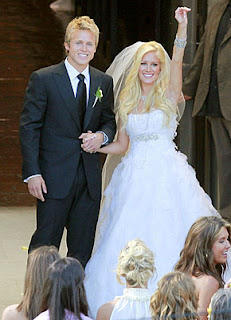
I guess the point I’m trying to fit into this rambling anti-marriage tirade is that Lahiri’s stories are so simple and yet so deep, that sentimentalists like Alex and cynics like me can both enjoy them. The beauty of Lahiri’s stories lies in their interpretation.
…of maladies.
Thursday, October 29, 2009
Language and Audience are related like Charlie Sheen and Emilio Estevez
OR: Read to the end for a neo-Nazi analogy…
We haven’t blogged in a couple of weeks, and now our first assignment after the layoff is a real head-scratcher: “What WOULD the works of Ha Jin and Conrad have been like if they hadn’t written in English?” It’s hard for me to project reactions that never happened, mostly because I like to be right and this is impossible to prove, but I think it’ll be interesting to think about the differences in how these works would have turned out if written in the authors’ native tongues.
For one thing (and I’m sure many if not all of us will mention this in some way) Ha Jin’s works would have been censored in China. No artist likes censorship, so I’m sure that was probably the biggest factor in his decision to write in English. However, since this is hypothetical anyway, had his works been written in Chinese AND been uncensored, they likely wouldn’t have gotten the adulation we English-speakers give them. The works help us question our cross-cultural relationships, and from instances in what we’ve read, the Chinese culture doesn’t embrace questioning, nor cross-cultural relationships. While I’m sure there would be many free-thinkers and scholars in China who would relate to and admire the stories, I’m fairly certain the other 1.3 billion people in China would either consider them smut or be indifferent. China is definitely becoming more accepting of changing points of view, but it still has a long way to go. Perhaps there will be more “free-thinking” literature written in Chinese in the future, but I think that right now China is still too used to the artistic oppression and isolation it has recently experienced to embrace stories like Ha Jin’s. In English, however, we can admire these works for their brilliant ability to show Western civilization not only what it’s like to live in China, but also how the Chinese think, and what they value. Reading these works of art is a great way to better know the Chinese, and to better understand how the Chinese view the West.
Conrad’s Heart of Darkness hits its audience better for being written in English as well. English speakers would have been far more struck by the effects of colonialism than Polish-speakers. Nothing against Poland, but I just don’t view it as a global imperial power. Conrad was obviously trying to shed some light on the brutalities a colonial system presents, and England was the preeminent colonial power, so it makes perfect sense for him to write in English. A Polish work by Jozef Korzeniowski 1) wouldn’t have reached an English audience concerned with its themes and 2) would have reached a Polish audience unconcerned with its themes.
In short, I think I can understand what Ha Jin was trying to say in his article: It’s important to match an audience with your work’s themes. You wouldn’t read a biochemistry lab report on golgi body sulfate metabolism to a class full of third-graders, and you wouldn’t read a pamphlet of neo-Nazi propaganda at a Synagogue (ta-da!). Once Ha Jin and Conrad both understood what issues were most important to them, they also realized that the English language would reach the audience most concerned with those issues.
We haven’t blogged in a couple of weeks, and now our first assignment after the layoff is a real head-scratcher: “What WOULD the works of Ha Jin and Conrad have been like if they hadn’t written in English?” It’s hard for me to project reactions that never happened, mostly because I like to be right and this is impossible to prove, but I think it’ll be interesting to think about the differences in how these works would have turned out if written in the authors’ native tongues.
For one thing (and I’m sure many if not all of us will mention this in some way) Ha Jin’s works would have been censored in China. No artist likes censorship, so I’m sure that was probably the biggest factor in his decision to write in English. However, since this is hypothetical anyway, had his works been written in Chinese AND been uncensored, they likely wouldn’t have gotten the adulation we English-speakers give them. The works help us question our cross-cultural relationships, and from instances in what we’ve read, the Chinese culture doesn’t embrace questioning, nor cross-cultural relationships. While I’m sure there would be many free-thinkers and scholars in China who would relate to and admire the stories, I’m fairly certain the other 1.3 billion people in China would either consider them smut or be indifferent. China is definitely becoming more accepting of changing points of view, but it still has a long way to go. Perhaps there will be more “free-thinking” literature written in Chinese in the future, but I think that right now China is still too used to the artistic oppression and isolation it has recently experienced to embrace stories like Ha Jin’s. In English, however, we can admire these works for their brilliant ability to show Western civilization not only what it’s like to live in China, but also how the Chinese think, and what they value. Reading these works of art is a great way to better know the Chinese, and to better understand how the Chinese view the West.
Conrad’s Heart of Darkness hits its audience better for being written in English as well. English speakers would have been far more struck by the effects of colonialism than Polish-speakers. Nothing against Poland, but I just don’t view it as a global imperial power. Conrad was obviously trying to shed some light on the brutalities a colonial system presents, and England was the preeminent colonial power, so it makes perfect sense for him to write in English. A Polish work by Jozef Korzeniowski 1) wouldn’t have reached an English audience concerned with its themes and 2) would have reached a Polish audience unconcerned with its themes.
In short, I think I can understand what Ha Jin was trying to say in his article: It’s important to match an audience with your work’s themes. You wouldn’t read a biochemistry lab report on golgi body sulfate metabolism to a class full of third-graders, and you wouldn’t read a pamphlet of neo-Nazi propaganda at a Synagogue (ta-da!). Once Ha Jin and Conrad both understood what issues were most important to them, they also realized that the English language would reach the audience most concerned with those issues.
Subscribe to:
Posts (Atom)