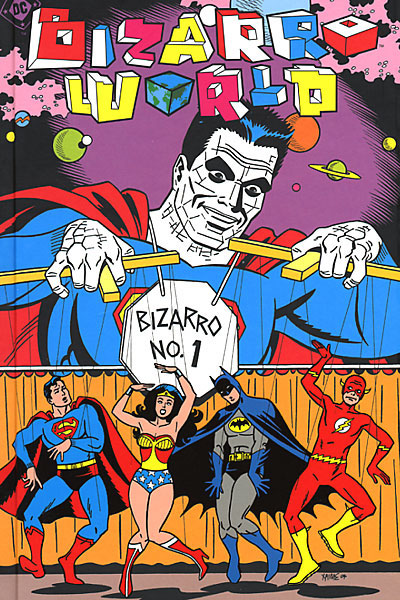
OR: Puberty is like Bazaar-o childhood
This has definitely been the hardest blog assignment so far. 1) I am not good at the "free for alls". They make me feel like a rudderless kite (does that make sense? It does to me somehow). B) Dubliners is so incredibly dense it was difficult for me to decide where to start. iii) We didn't discuss these in class so I didn't know what people would be interested in.
So when in doubt, I do a close read and pick something that interests me. I love how Joyce captures attitudes and moments from different stages of life, so I decided to do a close read of the first part of Araby to show how he is able to exhibit male adolescence so beautifully. Almost as well as Judy Blume.
First of all, I had read Dubliners before and was pretty disappointed that we weren't going to read "Counterparts". That story is my favorite (and one of my top 10 favorite short stories by any author) and I encourage all of you to read it. Especially if you hate your boss. Or your kids. (Joking about the kids. I'm not a terrible person, really.) But "Araby" is really good too.
Joyce does a remarkable job of describing adolescence and the disconnect between the mind and the body during this time. Joyce's narrator has trouble rationalizing his feelings and owes it to his "confused adoration" (251). His infatuation with Mangan's sister is all the more powerful because the narrator has never had these feelings before. A first crush is more intense than a tenth crush, and sprinkle in a little Irish Catholicism and the reader understands why this poor kid feels like his body is betraying him. "Her name often sprang to my lips at moments in strange prayers....My eyes were often full of tears (I could not tell why) and at times a flood from my heart seemed to pour itself out into my bosom" (250-1). The narrator feels "her name was like a summons to all my foolish blood" (250) because she is riling up these feelings that he doesn't understand and can rationalize. All he knows is that he likes her movement "[h]er dress swung as she moved her body and the soft rope of her hair tossed from side to side" (250) and the way the light hits "the white curve of her neck" (251). He has no idea why.
Joyce sums up the tension and sensation of puberty with one incredible analogy: "my body was like a harp and her words and gestures were like fingers running up the wires" (251). The tightness of a harp's wires evoke the tension in the narrator's body, and the vibrations caused by Mangan's sister show the disruption caused to a young man's psyche by feelings he doesn't understand. While many people find the ending of Araby leaves much to be desired (why doesn't he buy her anything?) we can easily see how it fits into the narrative. Joyce's story captures the complex emotions of adolescence in 5 pages; it took Judy Blume 164.
Saturday, November 14, 2009

Friday, November 6, 2009
A Series of Dreary Theories on Lahiri
OR: Please respond with Queries
I would like to start by saying that all of the blog posts I read were very thought-provoking. Well played, Nightside Crowd.
One of the posts in particular, however, spurred me to post in response because it made a point about the stories that I didn’t quite catch. Alex’s post made a number of really cool points about the interconnectivity of Lahiri’s stories through the idea of marriage, and the cultural differences between Indian and American concepts of matrimony. Alex brought up the fact that in each of the four stories we read, marriage was a central issue, and that each story looked at different issues about marriage and from different perspectives. I think this is an excellent way of looking at this group of four stories in particular.
Alex’s conclusion that the marriages in Lahiri’s stories are “a necessary aspect of life, something needed in order to live happily and feel fulfilled” shocked me because in reading the stories, I saw a lot of negativity surrounding the marriages in IoM. There was a miscarriage that led to two people falling out of love, a secret infidelity that spawned a child, an implied incestuous+adulterous rape that spawned another child, and an arranged wedding between two strangers that turned out to be the healthiest marriage in the book. My opinion on reading the stories was that marriage was the cause of a lot of emotional strain and conflict, and in many cases can ruin people’s lives.
So I went back and re-read some of the parts of the stories that Alex pointed out to see if I was just jaded and completely missed the point. I wanted to try to read the marriages as positive, and see if the stories could end happily ever after. And I found out that, yes, you could read the stories and think “these characters had their problems, but they are going to work through them and be better off in the long run. I guess love conquers all.” There is enough left up to the reader in Lahiri’s stories to draw conclusions as different as “marriage is hell” and “marriage is bliss.” Personally, I think I will stick with my view that marriage is ugly, stressful, complicated, painful, and licenses should only be given to people who go through a screening process as rigorous as the FBI’s. Maybe (okay, likely) ((okay definitely)) it stems from my experience writing settlement demands for a divorce lawyer, but I firmly believe people like this should be forbidden to marry:
I would like to start by saying that all of the blog posts I read were very thought-provoking. Well played, Nightside Crowd.
One of the posts in particular, however, spurred me to post in response because it made a point about the stories that I didn’t quite catch. Alex’s post made a number of really cool points about the interconnectivity of Lahiri’s stories through the idea of marriage, and the cultural differences between Indian and American concepts of matrimony. Alex brought up the fact that in each of the four stories we read, marriage was a central issue, and that each story looked at different issues about marriage and from different perspectives. I think this is an excellent way of looking at this group of four stories in particular.
Alex’s conclusion that the marriages in Lahiri’s stories are “a necessary aspect of life, something needed in order to live happily and feel fulfilled” shocked me because in reading the stories, I saw a lot of negativity surrounding the marriages in IoM. There was a miscarriage that led to two people falling out of love, a secret infidelity that spawned a child, an implied incestuous+adulterous rape that spawned another child, and an arranged wedding between two strangers that turned out to be the healthiest marriage in the book. My opinion on reading the stories was that marriage was the cause of a lot of emotional strain and conflict, and in many cases can ruin people’s lives.
So I went back and re-read some of the parts of the stories that Alex pointed out to see if I was just jaded and completely missed the point. I wanted to try to read the marriages as positive, and see if the stories could end happily ever after. And I found out that, yes, you could read the stories and think “these characters had their problems, but they are going to work through them and be better off in the long run. I guess love conquers all.” There is enough left up to the reader in Lahiri’s stories to draw conclusions as different as “marriage is hell” and “marriage is bliss.” Personally, I think I will stick with my view that marriage is ugly, stressful, complicated, painful, and licenses should only be given to people who go through a screening process as rigorous as the FBI’s. Maybe (okay, likely) ((okay definitely)) it stems from my experience writing settlement demands for a divorce lawyer, but I firmly believe people like this should be forbidden to marry:
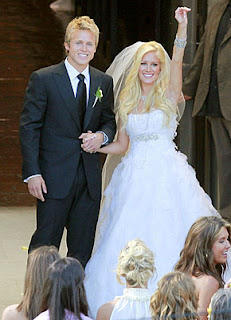
I guess the point I’m trying to fit into this rambling anti-marriage tirade is that Lahiri’s stories are so simple and yet so deep, that sentimentalists like Alex and cynics like me can both enjoy them. The beauty of Lahiri’s stories lies in their interpretation.
…of maladies.
Thursday, October 29, 2009
Language and Audience are related like Charlie Sheen and Emilio Estevez
OR: Read to the end for a neo-Nazi analogy…
We haven’t blogged in a couple of weeks, and now our first assignment after the layoff is a real head-scratcher: “What WOULD the works of Ha Jin and Conrad have been like if they hadn’t written in English?” It’s hard for me to project reactions that never happened, mostly because I like to be right and this is impossible to prove, but I think it’ll be interesting to think about the differences in how these works would have turned out if written in the authors’ native tongues.
For one thing (and I’m sure many if not all of us will mention this in some way) Ha Jin’s works would have been censored in China. No artist likes censorship, so I’m sure that was probably the biggest factor in his decision to write in English. However, since this is hypothetical anyway, had his works been written in Chinese AND been uncensored, they likely wouldn’t have gotten the adulation we English-speakers give them. The works help us question our cross-cultural relationships, and from instances in what we’ve read, the Chinese culture doesn’t embrace questioning, nor cross-cultural relationships. While I’m sure there would be many free-thinkers and scholars in China who would relate to and admire the stories, I’m fairly certain the other 1.3 billion people in China would either consider them smut or be indifferent. China is definitely becoming more accepting of changing points of view, but it still has a long way to go. Perhaps there will be more “free-thinking” literature written in Chinese in the future, but I think that right now China is still too used to the artistic oppression and isolation it has recently experienced to embrace stories like Ha Jin’s. In English, however, we can admire these works for their brilliant ability to show Western civilization not only what it’s like to live in China, but also how the Chinese think, and what they value. Reading these works of art is a great way to better know the Chinese, and to better understand how the Chinese view the West.
Conrad’s Heart of Darkness hits its audience better for being written in English as well. English speakers would have been far more struck by the effects of colonialism than Polish-speakers. Nothing against Poland, but I just don’t view it as a global imperial power. Conrad was obviously trying to shed some light on the brutalities a colonial system presents, and England was the preeminent colonial power, so it makes perfect sense for him to write in English. A Polish work by Jozef Korzeniowski 1) wouldn’t have reached an English audience concerned with its themes and 2) would have reached a Polish audience unconcerned with its themes.
In short, I think I can understand what Ha Jin was trying to say in his article: It’s important to match an audience with your work’s themes. You wouldn’t read a biochemistry lab report on golgi body sulfate metabolism to a class full of third-graders, and you wouldn’t read a pamphlet of neo-Nazi propaganda at a Synagogue (ta-da!). Once Ha Jin and Conrad both understood what issues were most important to them, they also realized that the English language would reach the audience most concerned with those issues.
We haven’t blogged in a couple of weeks, and now our first assignment after the layoff is a real head-scratcher: “What WOULD the works of Ha Jin and Conrad have been like if they hadn’t written in English?” It’s hard for me to project reactions that never happened, mostly because I like to be right and this is impossible to prove, but I think it’ll be interesting to think about the differences in how these works would have turned out if written in the authors’ native tongues.
For one thing (and I’m sure many if not all of us will mention this in some way) Ha Jin’s works would have been censored in China. No artist likes censorship, so I’m sure that was probably the biggest factor in his decision to write in English. However, since this is hypothetical anyway, had his works been written in Chinese AND been uncensored, they likely wouldn’t have gotten the adulation we English-speakers give them. The works help us question our cross-cultural relationships, and from instances in what we’ve read, the Chinese culture doesn’t embrace questioning, nor cross-cultural relationships. While I’m sure there would be many free-thinkers and scholars in China who would relate to and admire the stories, I’m fairly certain the other 1.3 billion people in China would either consider them smut or be indifferent. China is definitely becoming more accepting of changing points of view, but it still has a long way to go. Perhaps there will be more “free-thinking” literature written in Chinese in the future, but I think that right now China is still too used to the artistic oppression and isolation it has recently experienced to embrace stories like Ha Jin’s. In English, however, we can admire these works for their brilliant ability to show Western civilization not only what it’s like to live in China, but also how the Chinese think, and what they value. Reading these works of art is a great way to better know the Chinese, and to better understand how the Chinese view the West.
Conrad’s Heart of Darkness hits its audience better for being written in English as well. English speakers would have been far more struck by the effects of colonialism than Polish-speakers. Nothing against Poland, but I just don’t view it as a global imperial power. Conrad was obviously trying to shed some light on the brutalities a colonial system presents, and England was the preeminent colonial power, so it makes perfect sense for him to write in English. A Polish work by Jozef Korzeniowski 1) wouldn’t have reached an English audience concerned with its themes and 2) would have reached a Polish audience unconcerned with its themes.
In short, I think I can understand what Ha Jin was trying to say in his article: It’s important to match an audience with your work’s themes. You wouldn’t read a biochemistry lab report on golgi body sulfate metabolism to a class full of third-graders, and you wouldn’t read a pamphlet of neo-Nazi propaganda at a Synagogue (ta-da!). Once Ha Jin and Conrad both understood what issues were most important to them, they also realized that the English language would reach the audience most concerned with those issues.
Friday, October 9, 2009
Christophine as a Tangential Character
OR: The critical voice of WSS
The issue I found the most compelling in Spivak's essay is the characterization of Christophine. According to Spivak, "She [Christophine] cannot be contained by a novel which rewrites a canonical English text within the European novelistic tradition in the interest of the white Creole rather than the native." (246) In summary, since Christophine lies outside the conventions of European literature, even though she is a very important character, she exists, figuratively, outside of the realm of the novel. Thus, Spivak concludes, Christophine exists to be a critical voice. Though I find the logic in concluding that Christophine is not privy to the rules of the narrative (because she is an outlier to European literature) to be a bit stretched, I do like the idea of Christophine being a tool with which to display criticism.
Spivak cites Christophine's confrontation with Rochester as an example of this narrative criticism offered by Christophine. I admit that it is a very good example, and I also saw it mirrored in her advice to Antoinette. While Christophine confronts Rochester to display her concerns, Antoinette's criticism comes in the form of advice: "You ask me a hard thing, I tell you a hard thing, pack up and go." (65). Christophine's sound advice seems indeed to lie outside of European convention, as Antoinette dismisses the advice of "this ignorant, obstinate old negro woman, who is not certain if there is such a place as England." (67). In my opinion, and I think most of today's contemporary readers would agree, all parties would have ended up happier if Antoinette would have indeed left Rochester (especially Antoinette). In this sense, tangential Christophine has the most common sense, because she is not encumbered by 19th century European concepts of marriage and shame in letting that marriage end. Antoinette and Rochester, as Europeans, would rather manipulate each other and wallow in unhappiness than simply admit the marriage wasn't going to work and end it.
I would like to reword Spivak's argument to be a little more concrete: "since Christophine does not share the European values of the white characters in WSS, she is allowed to be critical of them. And since today's contemporary reader can relate to Christophine, Christophine can be seen as an external, critical voice in the novel." I certainly agree with this evaluation. Christophine's criticism of England, "Why you want to go to this cold, thief place?" (67), allows the reader to be critical as well.
Christophine is a very unique and useful character, in the sense that her criticisms within the novel contain instances of feminist, postcolonial, and uniquely West Indian ideals. I see Christophine as the most relatable character to today's WSS audience.
The issue I found the most compelling in Spivak's essay is the characterization of Christophine. According to Spivak, "She [Christophine] cannot be contained by a novel which rewrites a canonical English text within the European novelistic tradition in the interest of the white Creole rather than the native." (246) In summary, since Christophine lies outside the conventions of European literature, even though she is a very important character, she exists, figuratively, outside of the realm of the novel. Thus, Spivak concludes, Christophine exists to be a critical voice. Though I find the logic in concluding that Christophine is not privy to the rules of the narrative (because she is an outlier to European literature) to be a bit stretched, I do like the idea of Christophine being a tool with which to display criticism.
Spivak cites Christophine's confrontation with Rochester as an example of this narrative criticism offered by Christophine. I admit that it is a very good example, and I also saw it mirrored in her advice to Antoinette. While Christophine confronts Rochester to display her concerns, Antoinette's criticism comes in the form of advice: "You ask me a hard thing, I tell you a hard thing, pack up and go." (65). Christophine's sound advice seems indeed to lie outside of European convention, as Antoinette dismisses the advice of "this ignorant, obstinate old negro woman, who is not certain if there is such a place as England." (67). In my opinion, and I think most of today's contemporary readers would agree, all parties would have ended up happier if Antoinette would have indeed left Rochester (especially Antoinette). In this sense, tangential Christophine has the most common sense, because she is not encumbered by 19th century European concepts of marriage and shame in letting that marriage end. Antoinette and Rochester, as Europeans, would rather manipulate each other and wallow in unhappiness than simply admit the marriage wasn't going to work and end it.
I would like to reword Spivak's argument to be a little more concrete: "since Christophine does not share the European values of the white characters in WSS, she is allowed to be critical of them. And since today's contemporary reader can relate to Christophine, Christophine can be seen as an external, critical voice in the novel." I certainly agree with this evaluation. Christophine's criticism of England, "Why you want to go to this cold, thief place?" (67), allows the reader to be critical as well.
Christophine is a very unique and useful character, in the sense that her criticisms within the novel contain instances of feminist, postcolonial, and uniquely West Indian ideals. I see Christophine as the most relatable character to today's WSS audience.
Saturday, October 3, 2009
Caribbean and the Occult
OR: Voodoo, Zombies, Santeria, and the Wide Sargasso Sea
When most Westerners think of the Caribbean, we think of white sandy beaches, steel drums, picturesque sunsets, rum barrels, pirates, and maybe Usain Bolt. A fixture on “Travel Channel” and “E!’s Wild On” programming, the Caribbean islands are framed as an exotic getaway, not a place of mystery and witchcraft.
Before reading this novel, I had never heard the term “Sargasso Sea” to describe the Caribbean region. After our discussion in class, it became apparent that Rhys used “Sargasso Sea” instead of “Caribbean Ocean” specifically because she wanted to avoid the imagery presented above, and instead evoke mystery and darkness. The Sargasso Sea is strange, dangerous, and vast. A Gothic novel set in the Caribbean? It actually works quite well.
The Caribbean has always had this relaxing, fun-loving façade, but with that comes a history of un-orthodox religious practices and a belief in the supernatural. WorldWide Religious News, a website that compiles news stories from around the web and categorizes them by religion and world region, has a ton of interesting articles on the Occult in the Caribbean (see the bullet points on the right), and how it is still thriving to this day.
The relationship between Voodoo, zombies, Santeria, and the Caribbean is actually quite fascinating. At the essence of all three is the fear of losing one’s free will. This is poignant when you realize that they began as systems of beliefs for African-Caribbean slaves. A slave was always fearful of losing control of his or her soul. It makes sense to think that by taking people from Africa to the islands, then treating them as property and forcing them to work, Westerners created this idea that Caribbean slaves had a tenuous grasp on their own souls. And it is very sad.
This idea relates perfectly to Wide Sargasso Sea, because the reader is always mindful of Antoinette’s impending insanity. Antoinette, in effect, loses her ability to control herself, which is the foundation for the beliefs of the Caribbean occult. The fact that she is not a slave reinforces the idea that all of us have a tenuous grasp on our humanity, no matter what social position we find ourselves in.
When most Westerners think of the Caribbean, we think of white sandy beaches, steel drums, picturesque sunsets, rum barrels, pirates, and maybe Usain Bolt. A fixture on “Travel Channel” and “E!’s Wild On” programming, the Caribbean islands are framed as an exotic getaway, not a place of mystery and witchcraft.
Before reading this novel, I had never heard the term “Sargasso Sea” to describe the Caribbean region. After our discussion in class, it became apparent that Rhys used “Sargasso Sea” instead of “Caribbean Ocean” specifically because she wanted to avoid the imagery presented above, and instead evoke mystery and darkness. The Sargasso Sea is strange, dangerous, and vast. A Gothic novel set in the Caribbean? It actually works quite well.
The Caribbean has always had this relaxing, fun-loving façade, but with that comes a history of un-orthodox religious practices and a belief in the supernatural. WorldWide Religious News, a website that compiles news stories from around the web and categorizes them by religion and world region, has a ton of interesting articles on the Occult in the Caribbean (see the bullet points on the right), and how it is still thriving to this day.
The relationship between Voodoo, zombies, Santeria, and the Caribbean is actually quite fascinating. At the essence of all three is the fear of losing one’s free will. This is poignant when you realize that they began as systems of beliefs for African-Caribbean slaves. A slave was always fearful of losing control of his or her soul. It makes sense to think that by taking people from Africa to the islands, then treating them as property and forcing them to work, Westerners created this idea that Caribbean slaves had a tenuous grasp on their own souls. And it is very sad.
This idea relates perfectly to Wide Sargasso Sea, because the reader is always mindful of Antoinette’s impending insanity. Antoinette, in effect, loses her ability to control herself, which is the foundation for the beliefs of the Caribbean occult. The fact that she is not a slave reinforces the idea that all of us have a tenuous grasp on our humanity, no matter what social position we find ourselves in.
Friday, September 18, 2009
Twins are Fady
OR Numerous instances of twins offending the gods in African culture
I went a different way with this blog post (it is a free-for-all, after all) and decided to do a bit of a research project involving a cultural phenominon I rediscovered while reading Things Fall Apart. The issue where the Igbo people put newborn twins in baskets and leave them to die bothers me. I have heard mulitple instances in African cultures where twins are hated and treated in this manner, and I wanted to see why this happens.
I read The Poisonwood Bible in 2005 and thought it was a terrific book about Africa. It examines many of the same subjects we have been discussing in class (PoCo, the other, etc.) and was probably my introduction to thinking about African culture and what Europeans have done to affect it.
Also, I was lucky enough to travel to Madagascar a little less than a year ago, where I visited a friend of mine who lives there working for an landscaping company that specializes in biodiversity planting to prevent erosion. He has been there for over four years, so he speaks the language and could tell me a lot about the culture. I experienced a lot in my short three week stay, discovering many differences between Gasy (short for Malagasy, which is the descriptive term for someone or something from Madagascar) and American culture, as well as many more similarities. I basically discovered that the people of Madagascar are really just like Americans, the only differences lay in cultural quirks. For instance, the kids in Madagascar revere pro wrestling, and John Cena in particular. Also, the most requested songs on the radio are 80's hair band power ballads, like this song.
Then we read Things Fall Apart, and of course, many of the same issues I discovered in Poisonwood Bible and experienced in Madagascar were reiterated and peaked my interest. One of these strange cultural quirks that kept reoccurring was the fear of twins. As we read in Things Fall Apart, newborn twins are abandoned in the forest because they are believed to attract evil spirits and offend the Earth goddess. Similarly, in Poisonwood Bible, twins of the villagers are immediately killed, and the villagers also fear the two twin missionary daughters. Finally, in Madagascar, I learned that American volunteers and the Malagasy government are working hard to fight the local superstition that twins are "fady" or offensive to the gods.
"Fady" is a pretty broad term in Madagascar, meaning anything from "please" to "sorry" to "excuse me" to "taboo" to "leave me alone" etc. Literally translated, it means taboo, but I think a better description is "offensive to the gods". Wearing a hat in a cave, for instance, is fady, because the spirits who live in the cave demand respect. To bear twins is fady, and often the twins are separated, abandoned, or given up for adoption. This goes right along with how twins are treated in The Poisonwood Bible and Things Fall Apart, but it is pretty disturbing to me. I felt compelled to do some research on the place of twins in African culture and see if most of the continent had this reaction to multiple births.
I discovered that most cultures in Africa honor and respect twins. This is more of what I expected, since children are, in my experience, universally venerated and loved. You would think that having multiple children would be viewed as blessing, especially in farming cultures where more labor is needed. I was somewhat relieved that twins weren't hated all across the continent, but I still wanted to look in to possible explanations as to why twins were feared in the Igbo, Congo, and Malagasy cultures.
Apparently, the occurrence of multiple births is high in West Africa. According to one study, the occurrence of fraternal twins is three times higher in West Africa than it is in most of the rest of the world. One explanation is yams, another is genes, but either way it is definitely higher. It's amazing to me that two cultures in West Africa saw this same issue so differently: The Igbo (Okonkwo's people) killed their twins, while the Yoruba saw them as a blessing. This article examines the differences between how these two cultures with regards to the twin question, and poses a possible explanation: that multiple births are for animals, making twins inhuman.
It is so incredible to try to see how different cultures evolve solutions or explanations to natural phenomena. Some cultures venerate the same things that other cultures disparage. It makes you realize that we all have to take a step back and think about cultural differences before we judge a custom as primitive or inferior.
I went a different way with this blog post (it is a free-for-all, after all) and decided to do a bit of a research project involving a cultural phenominon I rediscovered while reading Things Fall Apart. The issue where the Igbo people put newborn twins in baskets and leave them to die bothers me. I have heard mulitple instances in African cultures where twins are hated and treated in this manner, and I wanted to see why this happens.
I read The Poisonwood Bible in 2005 and thought it was a terrific book about Africa. It examines many of the same subjects we have been discussing in class (PoCo, the other, etc.) and was probably my introduction to thinking about African culture and what Europeans have done to affect it.
Also, I was lucky enough to travel to Madagascar a little less than a year ago, where I visited a friend of mine who lives there working for an landscaping company that specializes in biodiversity planting to prevent erosion. He has been there for over four years, so he speaks the language and could tell me a lot about the culture. I experienced a lot in my short three week stay, discovering many differences between Gasy (short for Malagasy, which is the descriptive term for someone or something from Madagascar) and American culture, as well as many more similarities. I basically discovered that the people of Madagascar are really just like Americans, the only differences lay in cultural quirks. For instance, the kids in Madagascar revere pro wrestling, and John Cena in particular. Also, the most requested songs on the radio are 80's hair band power ballads, like this song.
Then we read Things Fall Apart, and of course, many of the same issues I discovered in Poisonwood Bible and experienced in Madagascar were reiterated and peaked my interest. One of these strange cultural quirks that kept reoccurring was the fear of twins. As we read in Things Fall Apart, newborn twins are abandoned in the forest because they are believed to attract evil spirits and offend the Earth goddess. Similarly, in Poisonwood Bible, twins of the villagers are immediately killed, and the villagers also fear the two twin missionary daughters. Finally, in Madagascar, I learned that American volunteers and the Malagasy government are working hard to fight the local superstition that twins are "fady" or offensive to the gods.
"Fady" is a pretty broad term in Madagascar, meaning anything from "please" to "sorry" to "excuse me" to "taboo" to "leave me alone" etc. Literally translated, it means taboo, but I think a better description is "offensive to the gods". Wearing a hat in a cave, for instance, is fady, because the spirits who live in the cave demand respect. To bear twins is fady, and often the twins are separated, abandoned, or given up for adoption. This goes right along with how twins are treated in The Poisonwood Bible and Things Fall Apart, but it is pretty disturbing to me. I felt compelled to do some research on the place of twins in African culture and see if most of the continent had this reaction to multiple births.
I discovered that most cultures in Africa honor and respect twins. This is more of what I expected, since children are, in my experience, universally venerated and loved. You would think that having multiple children would be viewed as blessing, especially in farming cultures where more labor is needed. I was somewhat relieved that twins weren't hated all across the continent, but I still wanted to look in to possible explanations as to why twins were feared in the Igbo, Congo, and Malagasy cultures.
Apparently, the occurrence of multiple births is high in West Africa. According to one study, the occurrence of fraternal twins is three times higher in West Africa than it is in most of the rest of the world. One explanation is yams, another is genes, but either way it is definitely higher. It's amazing to me that two cultures in West Africa saw this same issue so differently: The Igbo (Okonkwo's people) killed their twins, while the Yoruba saw them as a blessing. This article examines the differences between how these two cultures with regards to the twin question, and poses a possible explanation: that multiple births are for animals, making twins inhuman.
It is so incredible to try to see how different cultures evolve solutions or explanations to natural phenomena. Some cultures venerate the same things that other cultures disparage. It makes you realize that we all have to take a step back and think about cultural differences before we judge a custom as primitive or inferior.
Thursday, September 10, 2009
Why Academics Should Continue Reading Heart of Darkness
OR: English professors can't have been terribly wrong for the last century, right?
My argument for in support of the professors who have taught and continue to teach Heart of Darkness is simple: Heart of Darkness should certainly be taught in colleges across the world because it is an incredibly dense work of fiction.
In my previous blog, I basically agreed with Chinua Achebe that Heart of Darkness is a racist text. Achebe makes numerous valid points explaining this, and I made a couple similar, less adequate references in support of the same. But while Achebe goes so far as to say Joseph Conrad was a racist and that it is an abomination that we teach his text , I say that the work itself is great enough that we can learn from it despite the contextual shortcomings of its author. I will concede that Heart of Darkness is racist. So is Shakespeare’s Othello. But like Othello, Conrad’s work is dripping with complexity: it can be studied as a literary work, as a psychological work, as a sociological work, as a historical work, as a political work, etc. You can see that complexity simply by looking at the different titles of the essays in our anthology. We, as readers, have to put the work’s racism in context and be able to draw pertinent conclusions from it in spite of its primitive views about race. I look at it this way: in 200 years, when the entire civilized world is vegetarian, are future students going to be barred from reading works by every barbarian who ate meat? I sure hope not, and I don’t think that will be the case.
Achebe argues that we must eradicate this text (and presumably all racist texts) from the Western Literary Canon (volume 59) because the only way the West will stop taking advantage of other races is through “abandonment of unwholesome thoughts” (348). I argue that cutting great, complex works out of our curriculum doesn’t help us remove our unwholesome thoughts. In fact, I believe that education is the driving factor in learning from our unwholesome thoughts and moving past them.
In short, with the benefit of hindsight, I think that minds across the globe can benefit a great deal from analyzing Heart of Darkness . Hopefully, academia has moved past looking at the work as a literal description of black people. Hopefully, academia has learned to contextualize a work when it is studied. Hopefully, academia is skilled enough at analyzing a complex work that it can look through the ugliness it presents and formulate new thoughts about the present and the past.
I think the biggest flaw in Achebe’s essay comes at the conclusion, wherein he decides against ending on a positive note:
“In my original conception of this essay I had thought to conclude it nicely on an appropriately positive note in which I would suggest from my privileged position in African and Western cultures some advantages the West might derive from Africa once it rid its mind of old prejudices and began to look at Africa not through a haze of distortions and cheap mystifications but quite simply as a continent of people….But… I realized no easy optimism was possible” (348).
His pessimism was the downfall of his essay. Just like the West needs to have more faith in Africans’ concept for humanity, Achebe needs to have more faith in the West’s.
(NOTE: Here’s a link to the definition of literary canon. I think it’s a very useful term for literature connoisseurs to know. Plus I sat for about ten minutes trying to remember the term and typing things like “what is the term for a group of literary works that is commonly taught in college courses” into Google before I finally remembered it. I’m trying to prevent you from doing the same.)
My argument for in support of the professors who have taught and continue to teach Heart of Darkness is simple: Heart of Darkness should certainly be taught in colleges across the world because it is an incredibly dense work of fiction.
In my previous blog, I basically agreed with Chinua Achebe that Heart of Darkness is a racist text. Achebe makes numerous valid points explaining this, and I made a couple similar, less adequate references in support of the same. But while Achebe goes so far as to say Joseph Conrad was a racist and that it is an abomination that we teach his text , I say that the work itself is great enough that we can learn from it despite the contextual shortcomings of its author. I will concede that Heart of Darkness is racist. So is Shakespeare’s Othello. But like Othello, Conrad’s work is dripping with complexity: it can be studied as a literary work, as a psychological work, as a sociological work, as a historical work, as a political work, etc. You can see that complexity simply by looking at the different titles of the essays in our anthology. We, as readers, have to put the work’s racism in context and be able to draw pertinent conclusions from it in spite of its primitive views about race. I look at it this way: in 200 years, when the entire civilized world is vegetarian, are future students going to be barred from reading works by every barbarian who ate meat? I sure hope not, and I don’t think that will be the case.
Achebe argues that we must eradicate this text (and presumably all racist texts) from the Western Literary Canon (volume 59) because the only way the West will stop taking advantage of other races is through “abandonment of unwholesome thoughts” (348). I argue that cutting great, complex works out of our curriculum doesn’t help us remove our unwholesome thoughts. In fact, I believe that education is the driving factor in learning from our unwholesome thoughts and moving past them.
In short, with the benefit of hindsight, I think that minds across the globe can benefit a great deal from analyzing Heart of Darkness . Hopefully, academia has moved past looking at the work as a literal description of black people. Hopefully, academia has learned to contextualize a work when it is studied. Hopefully, academia is skilled enough at analyzing a complex work that it can look through the ugliness it presents and formulate new thoughts about the present and the past.
I think the biggest flaw in Achebe’s essay comes at the conclusion, wherein he decides against ending on a positive note:
“In my original conception of this essay I had thought to conclude it nicely on an appropriately positive note in which I would suggest from my privileged position in African and Western cultures some advantages the West might derive from Africa once it rid its mind of old prejudices and began to look at Africa not through a haze of distortions and cheap mystifications but quite simply as a continent of people….But… I realized no easy optimism was possible” (348).
His pessimism was the downfall of his essay. Just like the West needs to have more faith in Africans’ concept for humanity, Achebe needs to have more faith in the West’s.
(NOTE: Here’s a link to the definition of literary canon. I think it’s a very useful term for literature connoisseurs to know. Plus I sat for about ten minutes trying to remember the term and typing things like “what is the term for a group of literary works that is commonly taught in college courses” into Google before I finally remembered it. I’m trying to prevent you from doing the same.)
Subscribe to:
Posts (Atom)